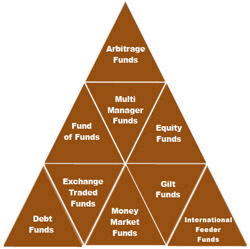
Types of Mutual Fund
Open-end funds
Open-end mutual funds must be willing to buy back
their shares from their investors at the end of
every business day at the net asset value computed
that day. Most open-end funds also sell shares to
the public every business day; these shares are
also priced at net asset value. A professional
investment manager oversees the portfolio, buying
and selling securities as appropriate. The total
investment in the fund will vary based on share
purchases, share redemptions and fluctuation in
market valuation. There is no legal limit on the
number of shares that can be issued.Open-end funds
are the most common type of mutual fund.
Closed-end funds
Closed-end funds generally issue shares to the
public only once, when they are created through an
initial public offering. Their shares are then
listed for trading on a stock exchange. Investors
who no longer wish to invest in the fund cannot
sell their shares back to the fund (as they can
with an open-end fund). Instead, they must sell
their shares to another investor in the market;
the price they receive may be significantly
different from net asset value. It may be at a
"premium" to net asset value (meaning
that it is higher than net asset value) or, more
commonly, at a "discount" to net asset
value (meaning that it is lower than net asset
value). A professional investment manager oversees
the portfolio, buying and selling securities as
appropriate.
Price (NET ASSET VALUE)
Net asset value or NAV
A fund's net asset value or NAV equals the current
market value of a fund's holdings minus the fund's
liabilities (sometimes referred to as "net
assets"). It is usually expressed as a
per-share amount, computed by dividing net assets
by the number of fund shares outstanding. Funds
must compute their net asset value according to
the rules set forth in their prospectuses. Funds
compute their NAV at the end of each day. Valuing
the securities held in a fund's portfolio is often
the most difficult part of calculating net asset
value. The fund's board typically oversees
security valuation.
Benefits of mutual funds?
1) Professional Financial Experts
2) Diversify Risk
3) Low Cost
4) Liquidity
5) Varity Of Investment
Why One should invest in mutual funds?
Reason 1:
They are investments instruments which are
capable of giving high returns . An average mutual
fund scheme returns easily beats inflation in
longer run and a good scheme can give far superior
returns.
Reason 2:
Our Mutual Fund industry is one of the best
regulated industry in the world. They are governed
by the strict guidelines layed down by
SEBI(Securities & Exchange Board of India).
Reason 3:
Investments decision of a Mutual Fund is taken by
their AMCs and Fund Managers. They are experts who
make investments decisions after doing intensive
research and analysis of a company & industry.
(Individuals generally don't have time and
resources to do research hence best option is to
let MF manage your investments)
Reason 4:
This industry is highly liquid. Even more liquid
than stock markets. Payments are generally made
through cheques or in some cases they are directly
credited to your bank accounts , If your bank is
allowing RTGS & electronic clearing and mutual
fund AMC is providing such facility.
Reason 5:
Investments are diversified into many companies
& sectors. Which make our investments safer
and consistent growth prospects. Diversifying is
usually not done by small investors , for such a
actions one requires lots of funds.
Reason 6 :
Tax treatments- Governments encourage investments
in capital markets and has given many tax sops.
Under i) 80(c) investments done upto one lakh in
specific mutual funds schemes which is called
ELSS(Equity Linked Saving Schemes.) are exempt
from tax. ii) Any units held for more than one
year if redeemed is treated under long term
capital gain tax which is zero percent currently
i.e. the whole profit is tax free. If one plans to
redeem before one year then he has to pay tax of
only15% on the profits.
Reason 7:
Mutual Funds are much cheaper compared to direct
exposure to capital market since one does not need
demat account ,annual charge to maintain account,
charges imposed on demat holdings, stamp duty on
transaction are not levied .
Now, let's assume that this group of individuals
is a novice in investing and so the group turns
over the pooled funds to an expert to make their
money work for them. This is what a professional
Asset Management Company does for mutual funds.
The AMC invests the investors' money on their
behalf into various assets towards a common
investment objective.
Hence, technically speaking, a mutual fund is an
investment vehicle which pools investors' money
and invests the same for and on behalf of
investors, into stocks, bonds, money market
instruments and other assets. The money is
received by the AMC with a promise that it will be
invested in a particular manner by a professional
manager (commonly known as fund managers). The
fund managers are expected to honor this promise.
The SEBI and the Board of Trustees ensure that
this actually happens.